Advertisement

    Courage and Love

    Wednesday, October 6, 2010, 9:23 AM [General]

    The way of love is not
    a subtle argument

    The door there
    is devastation.

    Birds make great sky-circles
    of their freedom.
    How do they learn it?

    They fall, and falling
    they're given wings.
    ~ Rumi


    My sister, Carla Zilbersmith, was this year's recipient of the Mary Lou Krauseneck Award for Courage and Love presented by ALS TDI. According to ALS TDI's website: 

    "This award is presented to a member of the ALS community who has, despite all obstacles, created a foundation of hope by maintaining a passion for life. The recipient of this award inspires his/her community to fight alongside them in the battle against ALS. He/She understands the importance of keeping a positive attitude and remains committed to finding a cure. This person is a model of strength, courage, and love in his/her community."


    I was given the honor of accepting the award on Carla’s behalf. The following is the acceptance speech I gave on that occasion.


    2010 Mary Lou Krauseneck Courage and Love Award Acceptance Speech

    First, I would like to thank ALS TDI for honoring Carla with this award. Carla passed away May 17th of this year, two and a half years after receiving her diagnosis. And though her loss is devastating to those who knew her and loved her, the impact on the world of her life, and the humor and the honesty with which she lived her life, is very much alive. This past weekend the film, Leave Them Laughing, a documentary about Carla, was screened at the Vancouver International Film Festival. It is incredible to think that through this film, Carla’s life will continue to inspire countless other lives with just those qualities for which she is being honored here today—Courage, Love and a passion for life.

    My sister Carla was a performer. An extraordinarily talented jazz singer, an outrageous and outrageously funny comedian, a writer of uncommon depth and honesty, an actor, a director, a provocateur, a songwriter, and an occasional poet. But Carla’s greatest talent was her humanity. She was a devoted mother, a wonderful sister and daughter, and a loving friend. Carla loved people, and she had the ability not only to be able to see the real essence of a person, but to express what she saw, to communicate in word and deed to you what she saw and loved about you.

    When Carla was first diagnosed, she was clear that she did not want to become a poster girl for ALS. In her blog she wrote, “I will not become a tireless crusader for a cure for ALS, I will not fight until the bitter end or be anyone’s poster-middle-aged-woman – rather I will do what we were all meant to do – be with people I love doing things that make me happy, trying to make the world a little brighter when I can and giving myself a break when I can’t.”

    Carla was not unaware of the irony, in fact she thought it was pretty funny, that not two years later, it was a photo of her that headed up the Calendar she had conceived as fundraiser for ALS TDI. She had become a tireless crusader and a poster girl for ALS and it happened because she did, as she said, what we were all meant to do—be with people she loved doing things that made her happy and trying to make the world a little brighter.

    Carla never felt that she was capable of the kind of dedication she had encountered in people like Corey Reich and his family, Toni and Warren Schiffer, Mary Harrington and so many others. She was awed but their endless capacity for giving, even in the face of their own personal tragedies. Carla considered herself a joker and an entertainer and felt that whatever she could offer would be in the example of her spirit for living and her prodigious creativity.

    It was out of this spirit that she conceived of the Always Looking Sexy Calendar. For Carla, a person’s humanity was always more important than their medical status, and she envisioned a pin up calendar with people at different stages in their progression of the disease. She wanted it to be sexy, she wanted it to be real and honest, and she wanted it to make a lot of money for ALS research. I know that she was always grateful for the enthusiasm with which ALS TDI embraced what for some was a controversial project.

    And this was truly an international project, with models from at least four different countries. In a matter of months Carla had coordinated models and photographers, printers and art directors, all while sitting as one of the models herself. It was a flurry of creative and administrative activity that would have taxed a healthy, able-bodied person, and she was tireless and dedicated.

    Whether battling her illness, confronting her own mortality, raising awareness for ALS and the need for a cure, or writing bravely and honestly about it all, Carla used humor. She never missed the opportunity for a joke, especially if that joke was in any way bawdy or inappropriate. And yet, she was never gratuitous. When Carla formed a Facebook group called “People with ALS for GIANT Gimpy Foam Hands”, it was not to make fun of the failing bodies of herself and those with ALS, but to bring awareness to those bodies and the souls of the people inhabiting those bodies. Her vision for the Giant Foam Hands was never realized, but I remember her telling me how beautiful she thought it would be to have an entire stadium of people holding up these giant, yet frail, bent hands. She wanted to shock people into awareness, yes, but she also wanted to remind us all of our fragility and our vulnerability, to remind us that we are all dying, whether we are ill or not. She wanted us to remember that we are all in this thing called life together and it is our job to make this world a little better and a little brighter if we can.

    And I think if Carla were here to receive the Courage and Love award she would say that the real courage is displayed by all of those who live their lives despite having ALS, who get up everyday to be with the people they love and do the things they love to do as long as they can. She would say that the real love is in the all the acts of caring—both great and small—given daily by families and caregivers of those with ALS. She would say that the people who have dedicated their professional lives to helping those suffering with ALS, or who devote their time and talent to finding a cure are the ones who display courage and love on a daily basis. She would look around her and say that everywhere you look you can see acts of courage and love and there just aren’t enough awards to recognize them all.

    Carla believed that despite the pain and the suffering, there were gifts and lessons to be gained from living with ALS. It was Carla’s mission in the last two years of her life to bring awareness to those gifts, the chief among them being that this life is precious and there is no time to waste in the living of it.

    I’ll close by giving the last words to Carla. This is an excerpt from her blog in which she describes the special knowledge that comes from living with ALS:


    “You know how life can knock the wind out of you so suddenly and you envy the innocence of the rest of the people around you who don’t realize that just like you they could die at any moment. You want people to know how hard it is, but you don’t want them to feel sorry for you or to think you’re brave or to give you the Olympic Gold Medal for Suffering. You want people to see how easy it would be for them to wake up one morning and decide to give up their self-inflicted pain and enjoy their wonderful life. How easy it is to have a great day when you can make and eat you own toast, throw on your own clothes, go out into the world and do whatever you damn well feel like.

    You want people to live all the life you’re going to miss.”


    2.8 (2 Ratings)

    Missing My Sister

    Tuesday, July 13, 2010, 10:04 PM [General]

    It's possible I am pushing through solid rock

    In flintlike layers, as the ore lies, alone;

    I am such a long way in I see no way through,

    and no space: everything is close to my face,

    and everything close to my face is stone.


    I don’t have much knowledge yet in grief

    so this massive darkness makes me small.

    You be the master: make yourself fierce, break in:

    then your great transforming will happen to me,

    and my great grief cry will happen to you.


    Rainer Maria Rilke


    My sister Carla died.

    No matter how many times I speak them, I can’t make that combination of words make sense. I know she is gone. It’s been over a month since she slipped into a coma, finally letting go three days later while surrounded by loved ones. I understand what the words mean. I said goodbye over Skype knowing that a few hours later she would be gone, I sat through the memorial when we all said and sang our goodbyes, I wandered through her house after most of the furniture had been moved out and only a few piles of things sat in the corners of the empty rooms. I know that it is true. My sister Carla died. Still, something in me just can’t comprehend…

    Grief comes like a punch in the gut. "I thought I was prepared for this," my father said, fighting through his tears to tell me the news, barely five minutes old. I sat on the other side of the phone line, on the other side of the country, feeling the wind being knocked out of me, even though I had known the reason for this call the moment the phone rang. Even though I, too, thought I'd prepared for this. For two and a half years and one of the longest weekends of my life I prepared. And then came my father's call...

    Rilke's image for grief is "pushing through solid rock," as though one were deep in the earth's core trying to push up into the light. It is a place where there is "no space" and "everything is close to my face." Claustrophobic. Immobile. Stuck. For me, grief is more like a fog or a cloud. I can't shake the feeling that I'm forgetting something or missing something. Like Rilke, "I am such a long way in I see no way through."

    . . .

    I wrote the above paragraphs a month ago. They took weeks to write. I could only manage a few sentences at a time and then I'd have to stop. It's been almost two months now since Carla died. That's the equivalent of about five minutes in grief time. The feelings are not so raw as they were a few weeks ago, but the pain is still very new. My feelings have hardened somewhat, less like a fog now, more like Rilke's stone.

    I understand Rilke's cry to God when he says, "You be the master: make yourself fierce, break in." I have always found comfort and pleasure in the practice of prayer and meditation. For me, religion has been a source of vitality. Like art, it is a way of making sense of the world, of being more alive to the world. And, like art, it is a discipline. It is hard work. In the face of grief, it is even harder. I still continue my regular practice of prayer, but it seems like I am simply going through the motions. I feel like a guy holding someone else's place in a long supermarket line that isn't moving. I'm just waiting and waiting, hoping to move forward soon. And so, like Rilke, I long for God to make his presence known. I need God to do all the heavy lifting right now. I need to know that there is meaning in the world, despite all the pain and sadness.

    After the death of his wife, C.S. Lewis wrote a book called A Grief Observed. In that book he says, "Talk to me about the truth of religion and I'll listen gladly. Talk to me about the duty of religion and I'll listen submissively. But don't come talking to me about the consolations of religion or I shall suspect that you don't understand." The easy pieties of "She's in a better place" just won't do. I don't want to feel okay that Carla is gone. I don't want to "get back to normal" and "feel good." Religion as an easy consolation would only be another form of repression. If anything, I believe that the hard work of religion means to feel more, not less. It means to look directly at difficult and painful realities and be transformed by them. Even so, I wish it didn't have to hurt so goddamn much.

    Somewhere inside me I can sense that I am being changed by this grief. It has to be so. After Carla's death, how could I ever be the same? I imagine that grief is God's way of working some mysterious alchemy in me. I can feel that that is true as I write it, and yet I'm not sure I believe it. Does that sound like a contradiction? Everything about grief is contradictory. This makes sense considering that the pain I feel at Carla's passing is in direct proportion to the love I had, and have, for her. And so I find I need God, but at the same time, I want nothing to do with him. I feel empty and desolate, and yet grief is the one place right now where I feel most fully alive. I want this pain to end, but it feels awful when I do feel better, like a kind of betrayal. I know that Carla is gone, but something in me will not believe it and acts and reacts as if she is still alive. "Like a phantom limb," my therapist said. "Like a phantom limb," I agreed.

    The question, of course, is, if I am being changed, what kind of change will it be? Will I shut down, repress my feelings, become colder, encased in the rock? Or will I find a new way into life, a new aliveness somehow birthed by this time of darkness? I honestly can't say right now how things will go -- I feel both of these possibilities within me everyday. But if I am going to get through this, even if I don't yet believe it, I have to have faith that new life can come out of this painful experience. I have always believed that we must be transformed by life, but you have to live through what is and not wish only for what you'd prefer life to be. And so all I can do right now is trust that by not resisting or denying this pain I can, by living through it, return to life renewed.

    Shortly before her death, Carla received a package of homemade butterflies made by the children of the playgroup that Allison leads, and that my kids attend. Carla wrote this thank you note to the children, which they received the day after she died:


    I was so excited to receive all of the butterflies you made me. I have a picture of them hanging in a fig tree in my backyard. I love butterflies because they are beautiful, but it takes a long time for them to change and a lot of hard work. It makes me feel like anybody can be beautiful if they work hard and are patient and kind, like butterflies. I have a bed in my backyard and I lie under an umbrella and look at your pretty presents. Thank you so much First Parish Playgroup.

    Love, Carla (Annabel and Atticus' Auntie Carla)

    I hope that through all this I may become a butterfly. I know that is what Carla would want. But she is right, becoming a butterfly is hard work. Right now, I am in the chrysalis stage -- hardly moving, dissolving, all the old forms breaking down, not sure if I'll ever emerge.

    At the memorial, towards the end, Atticus said, "Why is this such a long funeral?" At the time, I didn't know what to say beyond, "It'll be over soon." Afterwards, I told Carla's good friend, Gina, about Atticus' remark. Her answer was brilliant and quick. Carla quick. "That's a great question," she said, "because the answer is: It was so long because Carla was loved so much!"

    I know that because of the love I have for Carla, and because I miss her so damn much, working through the chrysalis of grief will be a long, hard process. My answer to Atticus was wrong -- it won't be over soon. I hope that I can honor this process, stay open even through the pain, the dislocation, and the uncertainty about where this all leads. I hope that I can return to the fullness of life, embracing it with the kind of joy and delight that Carla always did.

    And I hope that with hard work and patience, one day I, too, can be beautiful.

    Like Carla was beautiful.

    Like she knew we all could be.


    4.1 (3 Ratings)

    The Way The Soul Moves

    Saturday, May 8, 2010, 8:29 PM [General]

    The Way the Soul Moves

    Not in space but through one’s life—
    above the rumbling trucks at dawn
    and down below footsteps leaving
    no impression on the concrete walk to work;
    Not clothed in subtleties of wardrobe,
    not named by title, raised by rank;
    under shakes and shingles not sheltered,
    nor housed by stucco or aluminum;

    No pocket can hold it quite so well
    as the mind, though not a mind
    calcified by calculation, for it cannot be figured
    in the yield of an IRA, nor made to appear
    through the magic of an interest rate;
    Of accounts it prefers the narrative,
    its currency the well-coined phrase—
    favoring the circumlocutory, evading

    the well-defined; and so we feel it
    only as it slips away, like the fluttering shock
    of blue jay vanishing among the trees,
    like night and its gossamer of dream,
    like love as fluid as a memory, like youth,
    like the day, like life in this borrowed body
    traveling through space for a space of time,
    for such a little space of time.

    2.3 (2 Ratings)

    Stronger Than Death

    Monday, April 19, 2010, 8:37 PM [General]

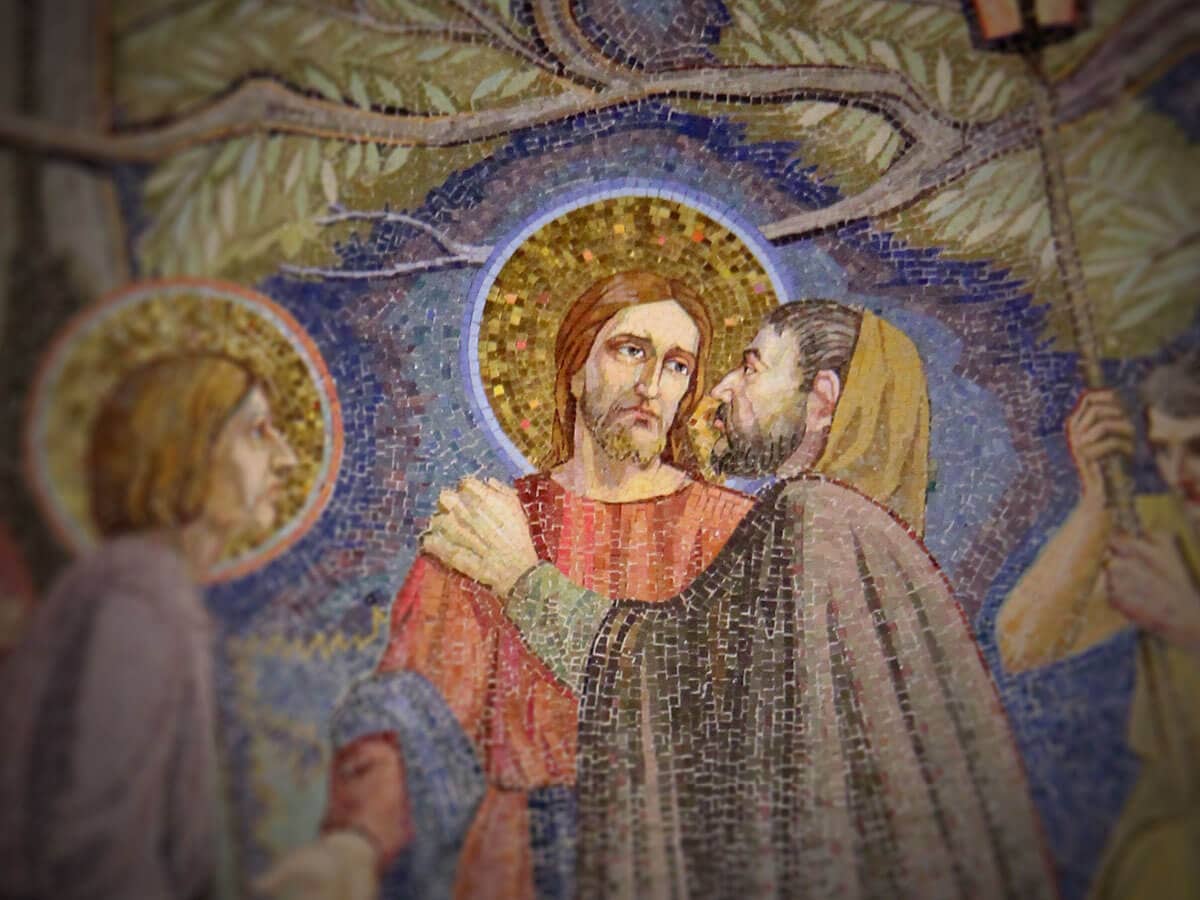
    Now on that same day two of them were going to a village called Emmaus, about seven miles from Jerusalem, and talking with each other about all these things that had happened. While they were talking and discussing, Jesus himself came near and went with them, but their eyes were kept from recognizing him. . . As they came near the village to which they were going, he walked ahead as if he were going on. But they urged him strongly, saying, “Stay with us, because it is almost evening and the day is now nearly over.” So he went in to stay with them. When he was at the table with them, he took bread, blessed and broke it, and gave it to them. Then their eyes were opened, and they recognized him; and he vanished from their sight. (Luke 24:13-16; 28-31)


    Relationships change us. From the beginning of our lives, key aspects of our personality—the way we experience ourselves and the world around us—are shaped by our primary relationships. If, as infants, we experience secure and stable attachments with our caregivers, we will develop a sense that the world is trustworthy and safe. If, on the other hand, our first relationships are unstable or otherwise traumatic, our ability to navigate the vicissitudes of life will be greatly impaired. Recent studies have shown that early healthy attachments lead to such things as greater self-esteem, greater life satisfaction, and a more robust immune system.

    In the most fundamental of ways, relationships change us.

    Later, as our worlds expand beyond the circle of family, our connections with others invite us to discover and develop wider dimensions to our personality. But this process of development is not something that is strictly an internal and individual affair. C.G. Jung states, “The meeting of two personalities is like the contact of two chemical substances: if there is any reaction, both are transformed.” This is the basic premise of psychotherapy, that change is effected by relationship.

    Religion, too, teaches that relationships can be transformative, particularly one’s relationship with God. All religions place central importance on the development of compassion, but it is Christianity, with its doctrine of the Trinity, that seems unique in asserting that relationship is not just something enjoined by God, it is the very nature of God. Referring to the idea of the Trinity, Huston Smith tells us, “If love is not just one of God’s attributes but his very essence—and it may be Christianity’s distinctive mission in history to claim just that—at no point could God have been truly God without being involved in relationship.” Looking closely at the story, quoted above, of Jesus talking with two disciples on the road to Emmaus, there is a hint that relationship is also an important factor in the mystery of resurrection.

    I can’t really speak to the theological understanding of resurrection as it is beyond the scope of my knowledge. And as for the spiritual reality of a life beyond this one, well, that is something that surpasses human knowing. It has always seemed likely to me that there is an existence that continues past this life, and I share Mary Oliver’s attitude in her poem, When Death Comes, when she says:

    “I want to step through the door full of curiosity, wondering:
    what is it going to be like, that cottage of darkness?”

    My personal belief is that death and resurrection are synonyms. Our death is an end on this plane of existence, but it is also an opening to a new and unknowable existence on some other level. A short while back, Carla woke and discovered that she had a sheet wrapped around her and could not move. ALS had left her too weak to free herself and too weak call for help. In order to avoid panic she imagined her body as a sandbag that she dropped off the side of a hot-air balloon. This allowed her to shift out of being identified with her trapped body and to find refuge in her free and soaring imagination. I believe our resurrection is like this, we let go of the body and become all soaring imagination. Or, maybe, it is like an actor walking off stage. We take off the costume and makeup of this character we’ve been playing and remember the wider, more complete personality that we’ve always been.

    One of the stories told in the Christian tradition during the Easter season is the appearance of Jesus to two disciples on the road to Emmaus. The two disciples are walking in a state of grief, discussing Jesus’ execution, when they are joined by a stranger. They invite the stranger to join them for dinner and when he blesses and breaks the bread, they suddenly recognize that it is Jesus. As soon as they recognize him, Jesus disappears.

    The word ‘companion’ is made from the words com- ‘with’ and panis ‘bread.’ To break bread with someone is to be in relationship with them. In this story, as I noted above, resurrection and relationship are joined together. In fact, in many of the post-resurrection stories, Jesus visits his disciples—his companions—and eats with them. This pairing of resurrection and relationship suggests one way to understand the mystery of life beyond this life. That is, we are most alive in this world and the next where we generate the most love, both given and received.

    This, to me, speaks to the psychological dimension of resurrection. Relationships change us. More than this. Who we are is to a large part determined by our interactions with others, good and bad. We are shaped by the successes and failures of love. Relationships not only change us, they create us. It is not too much, I believe, to say that the primary place of relationships in our lives means that we are not confined to our personal, separate selves. We are not merely our egos. We are what happens in the space between two (or more) people.

    Certainly, we continue to live on in the memories of those we have loved and those who have loved us. But I am suggesting that we live on in more than just memories. If we are made up of our relationships, then in every person we have met and loved some part of our being has been planted . We live not only in the memories of another, but in his or her very being. Maybe those who are left behind are like pieces in a great puzzle of love. When two or more of the people who have loved us in this life meet again after we are gone, the pieces come together and, in that moment, we are resurrected, we are alive again. We are, in a sense, put back together in those meetings. We are re-membered.

    And this to me is where the psychological dimension of resurrection opens out into the spiritual dimension. Maybe our spiritual existence is built up of the love we have generated in the world. The more love we have known, the more our spirit takes on a substantial existence able to become a living presence long after we have released the ballast that is our mortal body. Life ends. Things decay. Even memories fade. Love never dies.

    “Love,” teaches Paul Tillich, — and I believe him with all my heart — “is stronger than death.”

    3.7 (1 Ratings)

    Mahatma Gandhi On God

    Monday, April 12, 2010, 8:13 PM [General]

    My attention was recently drawn to this audio clip of Mahatma Gandhi by a friend. Gandhi's name has been used a little too profanely in this blog the last couple of posts. I post this now as a corrective.

    "I can see that in the midst of death, life persists; in the midst of untruth, truth persists; in the midst of darkness, light persists. Hence I gather that God is life, truth, light. He is Love. He is the supreme good."


    0 (0 Ratings)

    Page 1 of 9  •  1 2 3 4 5 6 ... 9 Next