Father,
Fill me with the truth of how much You love and have forgiven me. Let it be the blood coursing through my veins and the air I breathe. Fill me to overflowing with Your love, grace and mercy that it may be like a river of living water flowing out of me and splashing on all who cross my path today. Let those who know You be cleansed, refreshed and encouraged to be a blessing to others. Let those who don't know You be filled with a sense of wonder and connect it with the hunger inside them to know the one who created them, loves them and sacrificed all to restore them to Himself. Use me today as a vessel for Your glory.
In Jesus name
Amen
A Morning Prayer
A Meaningful Life
We are all born with a longing deep within us, an emptiness that only one thing can ever truly fill. Some go their whole life and never know it. I am reminded of how Solomon, the wisest man to ever live, sought to find meaning in every avenue known to man. Wealth. Power. Accomplishment. Pleasure. He found them all to be worthless and hollow. Finding meaning in them was as pointless as "chasing after the wind." The only answer he arrived at was this: Fear God and keep His commands, for this is the whole duty of man.
On the surface, fear and obedience hardly seem capable of filling the void in us. They appear small, cold and comfortless. How can they truly offer us meaning? Let us start by examining the first, fear.
The primary meaning for the Hebrew word for fear used here is "to stand in awe of, to give reverence, honor and respect." In other words, we are called to understand the greatness and majesty of the one who created us. We are called to worship Him and Him only. Understand, when I say worship, I do not simply mean what we do for about an hour or two on Sunday and maybe Wednesday. Romans 12:1 says "Therefore, I urge you, brothers and sisters, in view of God's mercy, to offer your bodies as a living sacrifice, holy and pleasing to God--this is your true and proper worship." Worship isn't simply something we do a few hours a week. It is something that permeates every aspect of our life. It is living a life that brings honor and glory to God from the moment we awake to the moment we lay our head down to sleep.
Next, we are called to obey God's commands. There are said to be 613 commands in the Old Testament, a staggering number. As difficult as it must be to learn and memorize all those rules, to perfectly obey them all is infinitely harder still. Jesus went on to sum them up in two. Love the Lord your God with all your heart, all your soul and all your mind. Love your neighbor as yourself.
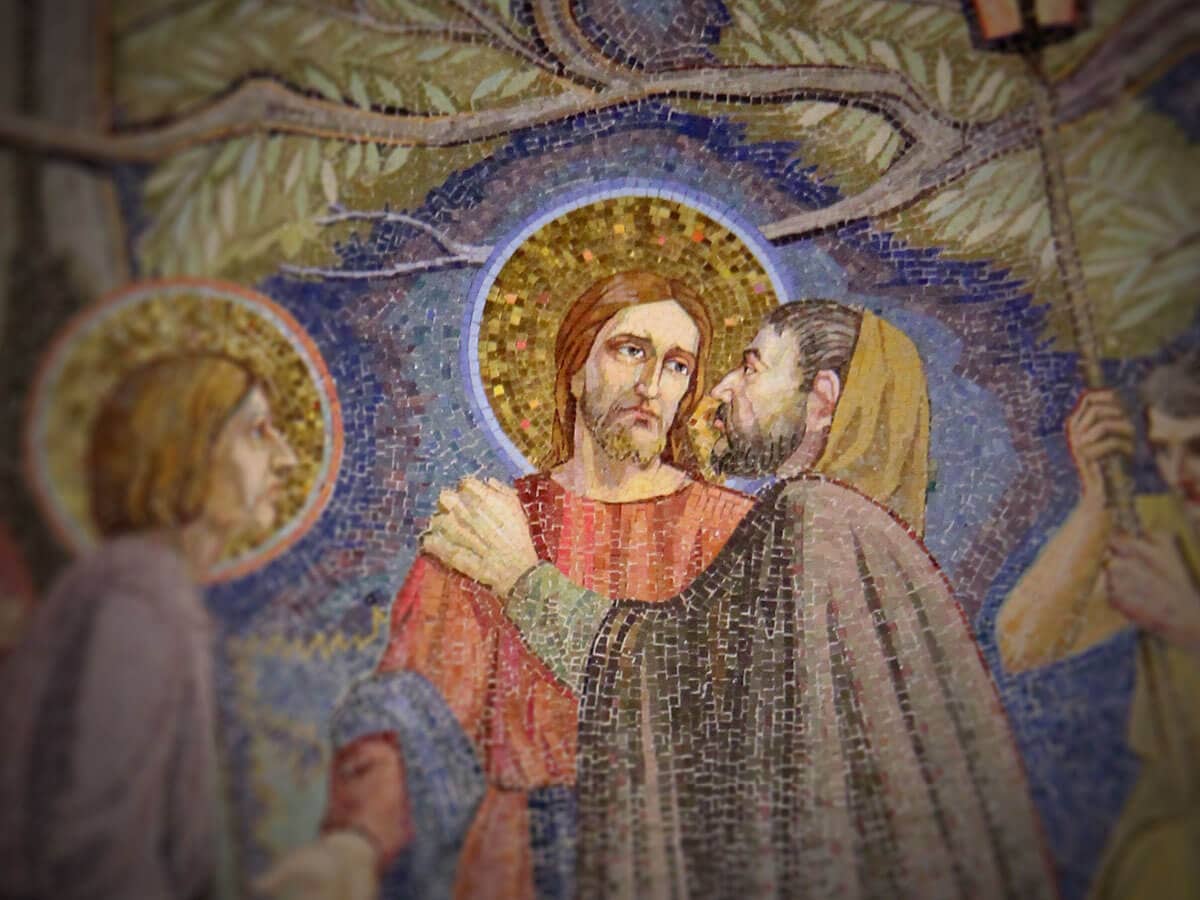
He refined them even further while speaking to his followers on the night he was to be betrayed. He told them "a new commandment I give you. Love one another. As I have loved you, so you must love one another. By this all men will know that you are my disciples, if you love one another."
Do not read this too quickly, lest you miss the beauty of what the words are saying. He is asking us to love as he loved us: an unselfish, sacrificial and unconditional love. How do we comprehend the magnitude of the all-powerful creator of EVERYTHING loving us so unconditionally? It is a love that seems like reckless abandon, as we could never deserve it. As it says in Romans 5:10 "For if, when we were enemies, we were reconciled to God by the death of his Son, much more, being reconciled, we shall be saved by his life." He chose to love us while we still hated Him. That is a love beyond understanding and measure.
And it is in believing that He loves us with this all-consuming love and letting it flow through us to all whom we encounter that we find meaning and purpose. Our emptiness is filled. We show to whom we belong, and point all the glory to Him.
Free Will of a Slave
Even as Christians, we struggle with the relationship of Free Will and God's ultimate control. Where does one begin and the other end. This question surfaced when a friend and I were discussing Romans 1:1. In this verse, Paul describes himself as a "servant of Christ." The Greek word is doulos, and means slave, one who is not free. The discussion was not if were were mere puppets of God, but just how free we were in choosing our actions. My reading on this verse, and Paul in general, led me to the following conclusions.
Because of his nature, Paul had a tendency to live in the extreme. He knew that his old life was slavery to the law, and to his service to the law, he was zealous, even to the killing of Christians.
Now, as a Christian, his zealous nature does not change, just the one he is in service to.
I think that, as a Roman, Paul used this term for slave in a way he never would have to a Jew. John 8:34-35 shows how Jesus was not listened to when he spoke to the Jews of their slavery to sin. Identifying yourself as a slave to them would make no sense, and Paul always knew his audience. Some of the hearers of this epistle were probably former or currents slaves. To hear Paul identify with them certainly perked their ears. Yet as the Gospel it laid out to them, they see that the type of "slave" that Paul is and the "Master" he serves are a radical departure to their world view. THAT is part of the nature of the Gospel. It radically challenges our world view (love your enemy, pray for those who persecute you, forgive your brother 70 times 7 times).
The Romans saw slavery as service compelled through force and fear. There may have been some exceptions to the rule, but I am sure that on the whole, there was little true love between slave and master.
The slave seemed to have no will of his own and obeyed, but only out of fear of punishment. The slave still had free will, but disobedience of the master resulted in severe punishment. The master used fear to keep the slave in line.
Paul is a slave to Christ, but not out of fear of damnation. He is a slave out of love for Christ because of how greatly he had been forgiven. Paul's reference to himself as a "chief among sinners" shows this.
Because he understood that "he was not his own, but bought at a great price," he literally saw himself as a slave to Christ. And as his self was "crucified with Christ and he no longer lived but Christ lived through him," he saw his will and dead and no longer running the show.
I guess Toby Mac was inspired by Paul when he wrote "Steal My Show". Same mentality. I am the slave and you are the Master, If you wanna steal my show, take it away. ;-)
Dan
Clarke's Commentary on the Bible
Paul, a servant of Jesus Christ - The word δουλος, which we translate servant, properly means a slave, one who is the entire property of his master; and is used here by the apostle with great propriety. He felt he was not his own, and that his life and powers belonged to his heavenly owner, and that he had no right to dispose of or employ them but in the strictest subservience to the will of his Lord. In this sense, and in this spirit, he is the willing slave of Jesus Christ; and this is, perhaps, the highest character which any soul of man can attain on this side eternity. "I am wholly the Lord's; and wholly devoted in the spirit of sacrificial obedience, to the constant, complete, and energetic performance of the Divine will." A friend of God is high; a son of God is higher; but the servant, or, in the above sense, the slave of God, is higher than all; - in a word, he is a person who feels he has no property in himself, and that God is all and in all.
Barnes' Notes on the Bible
A servant - This name was what the Lord Jesus himself directed His disciples to use, as their general appellation; Matthew 10:25; Matthew 20:27; Mark 10:44. And it was the customary name which they assumed; Galatians 1:10; Colossians 4:12; 2 Peter 1:1; Jude 1:1; Acts 4:29; Titus 1:1; James 1:1. The proper meaning of this word servant, δοῦλος doulos, is slave, one who is not free. It expresses the condition of one who has a master, or who is at the control of another. It is often, however, applied to courtiers, or the officers that serve under a king: because in an eastern monarchy the relation of an absolute king to his courtiers corresponded nearly to that of a master and a slave. Thus, the word is expressive of dignity and honor; and the servants of a king denote officers of a high rank and station. It is applied to the prophets as those who were honored by God, or especially entrusted by him with office; Deuteronomy 34:5; Joshua 1:2; Jeremiah 25:4. The name is also given to the Messiah, Isaiah 42:1, "Behold my servant in whom my soul delighteth," etc.; Isaiah 53:11, "shall my righteous servant justify many." The apostle uses it here evidently to denote his acknowledging Jesus Christ as his master; as indicating his dignity, as especially appointed by him to his great work; and as showing that in this Epistle he intended to assume no authority of his own, but simply to declare the will of his master, and theirs.
Vincent's Word Studies
A servant (δοῦλος)
Lit., bond-servant or slave. Paul applies the term to himself, Galatians 1:10; Philippians 1:1; Titus 1:1; and frequently to express the relation of believers to Christ. The word involves the ideas of belonging to a master, and of service as a slave. The former is emphasized in Paul's use of the term, since Christian service, in his view, has no element of servility, but is the expression of love and of free choice. From this stand-point the idea of service coheres with those of freedom and of sonship. Compare 1 Corinthians 7:22; Galatians 4:7; Ephesians 6:6; Philemon 1:16.
On the other hand, believers belong to Christ by purchase (1 Corinthians 6:20; 1 Peter 1:18; Ephesians 1:7), and own Him as absolute Master. It is a question whether the word contains any reference to official position. In favor of this it may be said that when employed in connection with the names of individuals, it is always applied to those who have some special work as teachers or ministers, and that most of such instances occur in the opening salutations of the apostolic letters. The meaning, in any case, must not be limited to the official sense.
David and Doeg
My current study book is called "A Workshop on David and His Psalms." This weeks reading involves how Saul's jealousy turned to murderous rage. In the story we are introduced to Doeg the Edomite. He was a convert to Judaism and Chief Shepherd to Saul. His story is found in 1 Samuel 21:1-9 and 22:6-23.
He was present when David fled to the priest Ahimelech, seeking provision. Doeg later informs Saul of Ahimelech's actions. Saul is enraged and after questioning to priest, has him and his family slaughtered. When his own soldiers refuse, Saul calls on Doeg, who gladly complies.
The study then draws parallels and contrasts between David and Doeg. Both were in the Shepherd trade. For David, it was a personal calling. He cared for the well being of the sheep and took care of them himself. He knew each one individually, and fought and killed bear and lion to protect them.
This part of why David was referred to as a "man after God's own heart."
God knows each one of us personally. He made us each unique and personally "formed us in our mother's womb." (Psalm 139:13 & Jeremiah 1:5) He loves us and cares for us. Jesus refers to himself as the "Good Shepherd" who cares so deeply for us that he literally gave is life to our salvation.
Doeg on the other hand, is "Chief of the Shepherds." He was not himself a
shepherd, but the overseer of the shepherds. This may have even been a position he gained through connections, as opposed to being promoted because of his abilities. Either way, he had no true connection to the sheep themselves. He did not know them and they did not know him. He is not a caretaker, but a manager; calculating and without compassion. His only concern is advancing through political maneuvering.
And now to the sad part of our story, and David's connection to Doeg. When David to Ahimelech, he lied to him. He deceived the priest by claiming that he was on a secret mission from the king. He manipulated the priest into giving him the only food that was available, the bread that was consecrated to God. Only the priests were allowed to eat this. He also takes the sword of Goliath, the giant that he killed. Ironic that that event both propelled him into Saul's favor and eventually his envy. David was afraid for his life, and understandably so. A mad king was trying to take his life. His sin was in trusting his own cunning to keep alive instead of relying on God. David's action would in part cost the priest his life.
Doeg also acts with deception and half-truth. Saul is raging about David's escape and wildly accusing everyone of conspiring with David. At this point, Doeg steps forward and tells Saul about how Ahimelech helped David with provisions. He neglects to mention David's deception, and that the priest believed he was aiding a mission of the king. He even mentions the sword, perhaps planting a seed of David's threat to Saul and the priests's part in a plot.
Saul has the priest brought before him. He does not seek truth from him, but only accuses him and David of treachery. Ahimelech, not understanding the full nature of his situation, defends David as one who is loyal to Saul and above reproach. More praise of David is more than Saul can bear, and orders Ahimilech and his family killed. The sole surviving member of the family flees to David, and tells him of the events. I believe that David was crushed in spirit. He confessed that he had seen Doeg there with the priests, and knew that Doeg would tell Saul. He admits that the blood in on his hands.
David responds with Godly sorrow. Godly Sorrow does not simply regret the
consequences, but grieves us of our very actions in the first place. He repents of his sin, and with a true shepherds heart, he takes the man under his protective care.
Doeg doesn't even see his actions as sin. Perhaps like Saul, he is so jealous of David that it was just a means to an end for him. Or maybe he viewed it as justice to kill the man who helped David. Either way, his blood lust did not stop with the priest and his family. It so consumed Doeg that he killed all the priests there, eighty-five in all. Even that was not enough. At Saul's command, he put to the sword Nob, town of the priests. Every living thing was killed; men, women, children, infants, and cattle.
How great is the consequences of our sin when, in our pride, we cling to our sin and refuse to repent?
In the end, Doeg and David are nothing alike. One allows his heart to grow cold and callous and the results were tragic. The other allowed God to reveal sin and break his heart. David would not go on to be the perfect king (only Jesus will do that). He would fall again more than once. His greatness as a leader would be his compassion for his people as their shepherd, and modeling a heart that was always broken before the Lord. Psalm 52 is David's response to the events of this story, a recording of how God had shaped his heart. In it, David speaks of how he came to trust in God's "unfailing love" and how he will put his hope in "God's name."
That is God's desire yours and my life. He wants us to trust in His unfailing love, a love we can never be good enough to earn. Hope not in your own strength, but "in His name, find hope, for His name is good."
Steal My Show
Steal My Show (TobyMac) www.godtube.com/watch/?v=0J91MJNU
"If You wanna steal my show, I'll sit back and watch You go
If You got somethin' to say, go on and take it away
Need You to steal my show, can't wait to watch You go
So take it away"
The song is autobiographical, about touring and performing. What I like is how it can translate to all of our lives.
As Christians, it is easy to get in the mode of going through life thinking "Oh, hi God. Nice to see You. This is what I am doing. If You wanna work in and through me and You have the time, I am okay with that."
God longs, however, to bring us to the point of "Wow God, why didn"t I see You there? I really NEED you to 'steal the show'. Regardless of how I look on the outside or how well I think I am doing, I can't do this without you. In fact, I don't even wanna try. When I let you run things, they come out so much better, and You always surprise me with the amazing things that come out of it when I do surrender to You."
What part of "The Show" are you still trying to run? Work? Family? Finances? Even if you are doing a fair job, He will do so much more than you can imagine if you let Him.
I love how The Message says it in Ephesians 3:20-21
"God can do anything, you know—far more than you could ever imagine or guess or request in your wildest dreams! He does it not by pushing us around but by working within us, his Spirit deeply and gently within us.
Glory to God in the church!
Glory to God in the Messiah, in Jesus!
Glory down all the generations!
Glory through all millennia! Oh, yes!"
Thoughts for a New Year
God places/allows difficulties in our live for various reasons. For me right now, they seem to be to discipline and funnel (draw) me back to Him. I need to return though, without just an attitude of avoiding further correction. I need to have an attitude of gratitude and joy for all He has blessed me with.
Let us all begin this new year with a deeper sense of gratitude for all we have, especially the non-material things.
Are You Thirsty?
“Are you not thirsty?" said the Lion.
"I am dying of thirst," said Jill.
"Then drink," said the Lion.
"May I — could I — would you mind going away while I do?" said Jill.
The Lion answered this only by a look and a very low growl. And as Jill gazed at its motionless bulk, she realized that she might as well have asked the whole mountain to move aside for her convenience.
The delicious rippling noise of the stream was driving her nearly frantic.
"Will you promise not to — do anything to me, if I do come?" said Jill.
"I make no promise," said the Lion.
Jill was so thirsty now that, without noticing it, she had come a step nearer.
"Do you eat girls?" she said.
"I have swallowed up girls and boys, women and men, kings and emperors, cities and realms," said the Lion. It didn't say this as if it were boasting, nor as if it were sorry, nor as if it were angry. It just said it.
"I daren't come and drink," said Jill.
"Then you will die of thirst," said the Lion.
"Oh dear!" said Jill, coming another step nearer. "I suppose I must go and look for another stream then."
"There is no other stream," said the Lion.”
― C.S. Lewis, The Silver Chair
All of us are thirsty at times. Our bodies need water to survive. Our spirits also thirst, thirst for purpose and meaning. We look to many things to quench that thirst.
The book of Ecclesiastes is all about how the wisest man that ever lived and how he tried everything (and I do mean EVERYTHING) to quench that thirst. Power, money, pleasure, sex and wine; You name it, he tried it. In the end, he found that purpose in this "Fear GodP)"> and keep his commandments, for this is the duty of all mankind."
God knows that we are thirsty. He asks that we come to Him to drink. He makes no promises as to what He will do in and through us, except that we can fully trust Him.
Will you trust Him? Or will you allow the thirst to drive you to places that will seem to satisfy, but in the end will simply leave you empty and wanting more?
Love Covers a Multitude of Sins
1 Peter 4:8
New International Version (NIV)
8 Above all, love each other deeply," because love covers over a multitude of sins.
I recently read this verse with new eyes. Always before, I had understood this verse to be about loving others and overlooking THEIR sin. We are called to love and forgive, and we do well to seek God's help in doing this. I think there is more that God desires though.
When we choose to obey, to love and forgive, we are also choosing to avoid sinning ourselves. Paul wrote to the Ephesians these words:
“In your anger do not sin”. Do not let the sun go down while you are still angry. (Ephesians 4:26)
And James reminds us in Chapter 1 verse 20:
because human anger does not produce the righteousness that God desires.
Choosing to love not only sets your brother or sister free, it sets you free. Choose to love and live in freedom.
Risky Love
I balk and complain that God asks me to love with no guarentee of return. It
isn't fair. God is all knowing, so for Him their is no real risk.
How can he understand my fear, how much I have to lose? If I love, I give away a piece of myself, the true "me". I have no way of knowing if they will give back
a piece of the true "them".
As if that isn't hard enough, I let them have an opportunity to reject me. To lose a piece of me AND have it rejected, how can He ask that? He can't understand what He asks.
Then I remember what He did. Not only did He give me a piece of Himself to live
inside me, He made that offer to everyone. As I let that sink in, I realize that He chose to love and offer that piece of Himself NOT just to those He knew would accept Him. That would have been safe, not very risky. No, He gave it to those that He knew would despise and reject His gift. I have no fore knowledge of if my gift of me will be rejected. For me, their can always be a chance. How dare I decide to love less than He does?
Page 1 of 5 • 1 2 3 4 5 Next